// instruments · resonance pump
resonance harvester
Resonance harvester system — large trampoline membrane · match the bounce · harvest strain as piezo. Parallel to grow-your-own solar on /locus.
Precision-engineered mat (stiffness, mass, damping) is tuned so its natural frequency meets the drive frequency of jumpers or foot traffic — resonance is the frequency, same rule as solar match. Damping would become heat (friction and material loss); piezo patches at high-strain zones intercept a fraction as electricity. Anchors hold the frame to the ground.
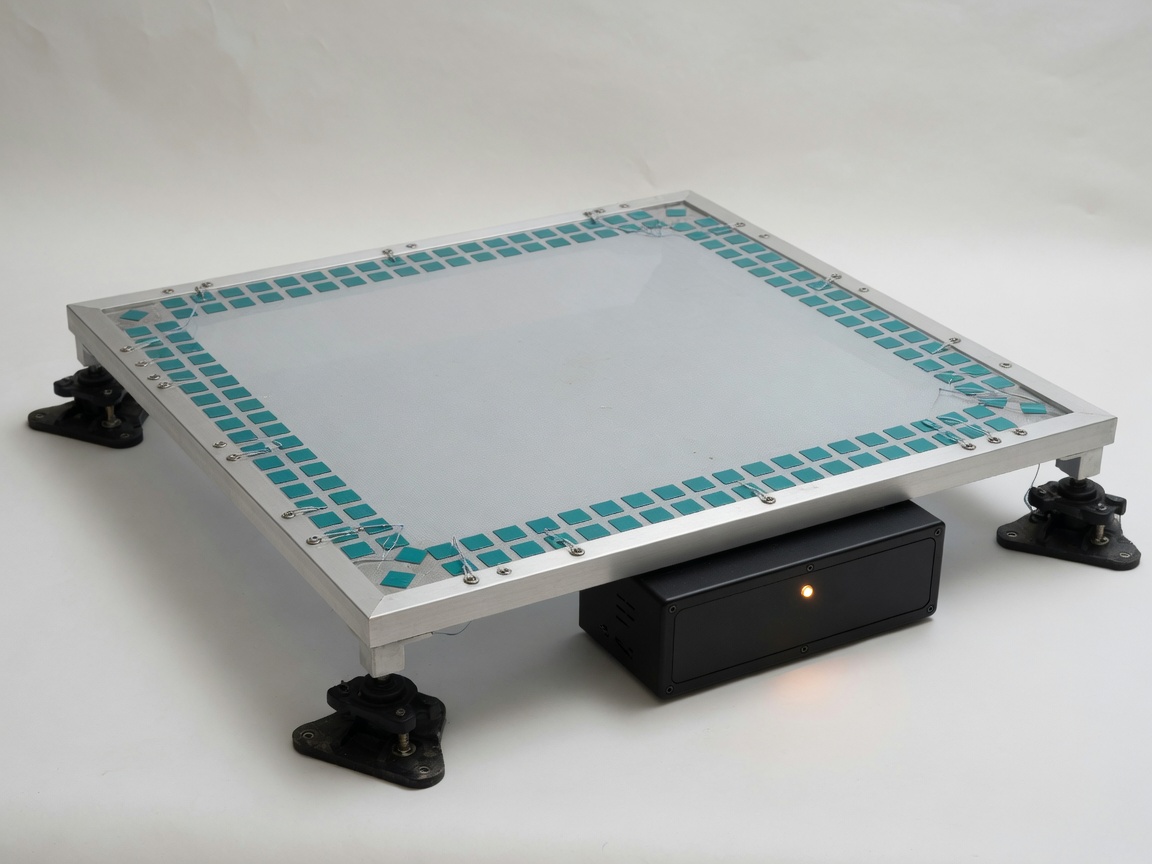
membrane · materials
drive · resonance
Natural frequency f₀ = √(k/m) / 2π. Match drive to f₀ for maximum amplitude and maximum damping power available to harvest. Detune and the mat goes quiet — less heat, less piezo.
honest ledger
Instantaneous: drive 0.0 W · piezo 0.0 W · heat 0.0 W. Cumulative electrical is always ≤ work in. Turn drive off and output dies — no ambient earth free lunch.
what this is
A resonance pump is a large mechanical resonator — trampoline-class membrane, precision fabrics and elastomers, tuned frame — driven by people, traffic, or coordinated bounce. At match frequency, displacement grows; strain in the mat and mounts peaks; piezoelectric elements convert cyclic strain into charge. Friction and viscoelastic loss are the heat path; η is the fraction of that loss channel you successfully route into electrical harvest instead of waste heat.
What is possible. Lab pads, plaza pads, court-scale membranes, multi-pad parks, hybrid campuses with grow-your-own solar, public joule dashboards, material R&D on k, m, γ, η, and pad density. Ground anchors hold the frame; drivers supply the work; piezo takes a designed fraction of strain. Expand from /locus/products#possible.
Product line and investor write-up: /locus/products#rp0 · materials-only costs /locus/costs#costs-rp0 (lab mid ~$420 · plaza mid ~$2,800 · court mid ~$9,500) · where to buy · stack map /locus · sister instrument /field/locus.
design knobs that matter
- f₀ match — materials and tension set k; mass loading sets m; tune or schedule drive Hz.
- Q / damping — too little damping, little harvestable power; too much, amplitude dies. Engineering trade.
- Piezo placement — high-strain zones (rim, nodes, mounts), not low-strain belly only.
- η honesty — real piezo harvesters are often single-digit to low tens of percent of mechanical loss; the slider tops at 40% to stay educational, not magical.
- Scale — more pads and larger drive force increase watts only if drivers supply the work.